
Tangential Flow Filtration for Efficient Depletion of Nanoparticles Contained in Fetal Bovine Serum
TFF-EVs can efficiently deplete FBS of nanoparticles.
Introduction
Fetal Bovine Serum (FBS) or Fetal Calf Serum (FCS) are commonly used supplements in cell culture media. However, using FBS, nanoparticles of bovine origin, such as lipoproteins and EVs, are introduced into the
culture medium, where they not only can modulate the signaling of the recipient cells but also contaminate the cell-derived vesicle preparation, co-isolating with them during the EV purification phase.
To date, several supplements or EV depleted sera are commercially available, as well as several protocols have been developed to remove FBS nanoparticles, mainly based on ultrafiltration or ultracentrifugation
methods.
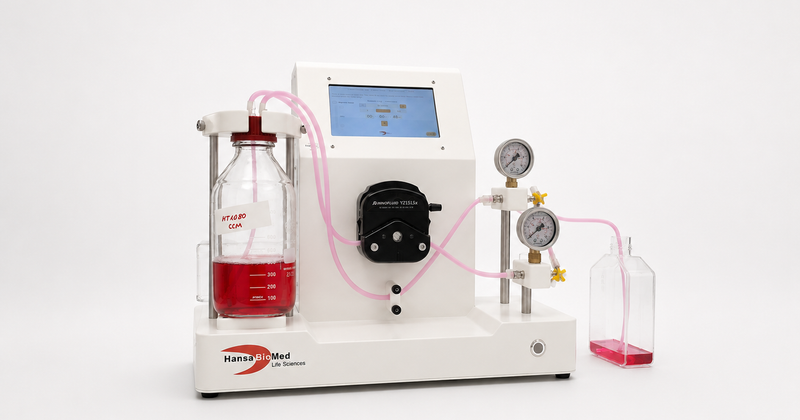
In this application note, we show how our TFF-EVs can be used to remove nanoparticles from FBS in one single filtration shot, working directly under the safety cabinet. A simple, fast and inexpensive way to drastically reduce the presence of nanoparticles in FBS, without impacting the cell growth and viability, and by preserving the sterility.
Workflow
1) 10 ml of raw FBS were depleted of nanoparticles flashing the fluid through TFF-EVs filter.
2) The particle content in raw FBS, the filtrate and the retentate were analyzed by the Zetaview analyzer (Particle Metrix). In order to evaluate the efficacy of the nanoparticle depletion, nanoparticles contained in FBS and FBS post filtration were isolated from the raw matrices by SEC and the particle yield determined by NTA.
3) The effect of FBS depletion was assessed in 3 different cell line, comparing the cell viability when cell are cultivated in medium FBS free, FBS-depleted and complete FBS.
Results
1) Analysis of Particles in Raw Fluids
Less than 1% of the total particles in the raw FBS were detected in the filtrate (FBS depleted).
| Sample | Particle Concentration (part/ml) | Particle Size (nm) | Volume (ml) | Total Particles |
|---|---|---|---|---|
| Unfiltered FBS | 1.40E+11 | 83.2 | 10 | 1.40E+12 |
| Retentate post-TFF-EVs filtration | 5.60E+11 | 91.9 | 2.4 | 1.34E+12 |
| Filtrate post-TFF-EVs filtration | 1.50E+09 | 85.8 | 8.5 | 1.28E+10 |
Table 1: NTA measurement results comparison
2) Analysis of Nanoparticle Fraction Post-SEC
The TFF-EVs filtration removes the majority of the nanoparticles from FBS.
| Sample | Particle Concentration (part/ml) | Particle Size (nm) | Volume (ml) | Total Particles |
|---|---|---|---|---|
| Nanoparticle fraction from raw FBS, post-SEC | 7.60E+10 | 95 | 2.5 | 1.90E+11 |
| Nanoparticle fraction from TFF-EVs filtrate, post-SEC | 2.50E+08 | 96.2 | 2.5 | 6.25E+08 |
Table 2: NTA measurement results comparison after SEC
3) Effect of FBS Nanoparticle Depleted in Cell Culture
Cell viability monitoring at 24h, 48h, 72h in HEK293, HCT116 and COLO1, cultivated respectively with medium FBS free (Serum Free), medium with the 10% of FBS-nanoparticle depleted (NP Depleated FBS) and medium with 10% of complete FBS (Complete FBS).
Conclusion
- TFF-EVs can be used for depleting FBS or other cell culture supplements from nanoparticles, including EVs.
- The operation can be run under the safery cabinet, preserving the cell and the medium sterility.
- The filtration through TFF-EVs removes the 99% of total FBS nanoparticles (retained by the filter).
- The use of nanoparticle-depleted FBS does not impact the cell viability.