
Sequential Tangential Flow Filtration for Purification of Plant-Derived Nanoparticles
TFF is an ideal method for scalable, high-throughput and high-purity isolation of EVs from various plant sources.
Introduction
Despite the presence of nanoparticles in plants was firstly observed in late '60s, dedicated research into plant-derived nanoparticles, commonly referred to as Plant EV-Like Nanoparticles (ELN) or more frequently as Plant-EVs, began just a decade ago. Today, plant ELNs represent a new frontier for the development of a new class of therapeutics—remarkably safe and highly biocompatible. This innovation holds significant potential, particularly in the cosmetic and nutraceutical industries, and offers novel alternatives for bioactive molecule delivery. ELNs from ginger, various berries, lemons, and grapefruits have exhibited distinct anti-inflammatory [1] and antioxidant activities [2]. Furthermore, these plant ELNs have demonstrated resilience against the harsh conditions of the stomach and intestine, successfully reaching the colon and potentially influencing the microbiota [3].
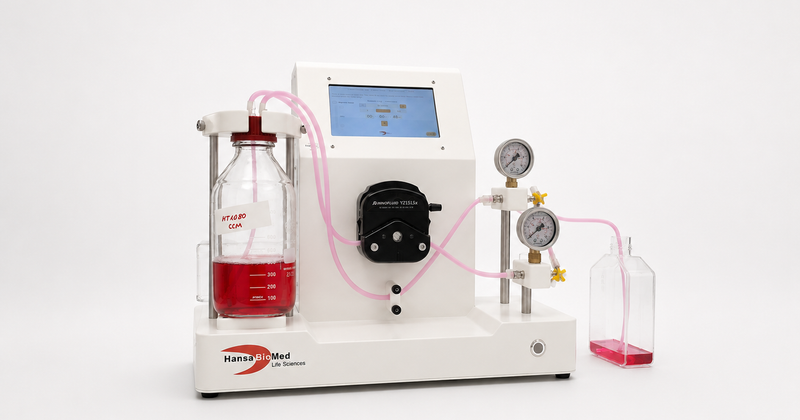
In this application note, we show the efficacy and cost-effectiveness of a sequential filtration approach employing TFF-MV (200 nm pore size) and TFF-EVs (50 nm pore size) for the isolation of plant ELNs. This method ensures optimal particle yield while preserving the biological effects of these intriguing nanoparticles.
Workflow
1. Sample preparation and precleaning: seaberries, ginger and garlic were minced in a juicer. Following macrofiltration and the removal of the the solid residue, the juice was filtered through 50 μm filter (Biocomma).
2. Tangential flow filtration for removal of large partilces and debris: the fluid was filtered through TFF-MV, 200 nm pore size, operating with peristaltic pump Masterflex L/S 7535-04 at 80 ml/min flow velocity.
3. Plant ELNs purification was performed by Tangential Flow Filtration through the TFF-EVs filter (50 nm pore size), operating with peristaltic pump Masterflex L/S 7535-04 at 80 ml/min flow velocity. Following 3 washing steps with 50 ml of PBS 1x (Corning), the plant nanoparticles were recovered in 5 ml of PBS 1x.
Results
1) Nanoparticle Concentration and Morphology
A. Nanoparticle Tracking Analysis (NTA), performed with Zetaview by Particle Metrix (Camera sensitivity 85, Shutter 100, Temperature 25°C)
| Sample | Particle Concentration (part/ml) | Mean Size (nm) | Volume (ml) | Total Particles |
|---|---|---|---|---|
| Garlic | 5.4x10E+11 | 82.5 +/- 6.6 | 5 | 2.7x10E+12 |
| Seaberry | 5.6x10E+11 | 117.8 +/- 11.4 | 5 | 2.8x10E+12 |
| Ginger | 4.0x10E+11 | 101.3 +/- 5.6 | 5 | 2.0x10E+12 |
Table 1: NTA results for different samples processed with NTA
B. Transmission electron microscopy (TEM) analysis
2) Particle Characterization and Biologic Activity
A. TET8 marker expression in purified ELNs
B. Lectin profiling in purified ELNs
kit I Fluorescein (Vector Lab)
C. Enzymatic activity assays in ginger ELNs
Conclusion
Combination of TFF-MV and TFF-EVs allows fast, scalable and cost effective purification of plant-derived nanoparticles (ELNs). Purified particles are suitable for functional assays and biomarker profiling.
References
[1] Chen, Xingyi, You Zhou, and Jiujiu Yu. "Exosome-like nanoparticles from ginger rhizomes inhibited NLRP3 inflammasome activation." Molecular
pharmaceutics 16.6 (2019): 2690-2699.
[2] Zhang, Mingzhen, et al. "Plant derived edible nanoparticles as a new therapeutic approach against diseases." Tissue barriers 4.2 (2016): e1134415.
[3] Munir, Javaria, Mihye Lee, and Seongho Ryu. "Exosomes in food: Health benefits and clinical relevance in diseases." Advances in Nutrition 11.3 (2020): 687-696.