
Going Beyond Eukaryotes: Purification of Bacterial EVs
Our TFF cartridges are useful not only for eukaryotic cells, but also for prokaryotic cells for high-yield EV isolation.
Introduction
Extracellular vesicles (EVs) from bacteria, specifically outer membrane vesicles (OMVs) are becoming prominent players of EV research and applications, proving to be promising for vaccine development, targeted drug delivery, and cosmeceutical applications [1,2]. Their advantages include not only efficient delivery following skin penetration due to their roles in host-microbiome interaction, but also easier source access and ethical handling compared to their mammalian counterparts [3].
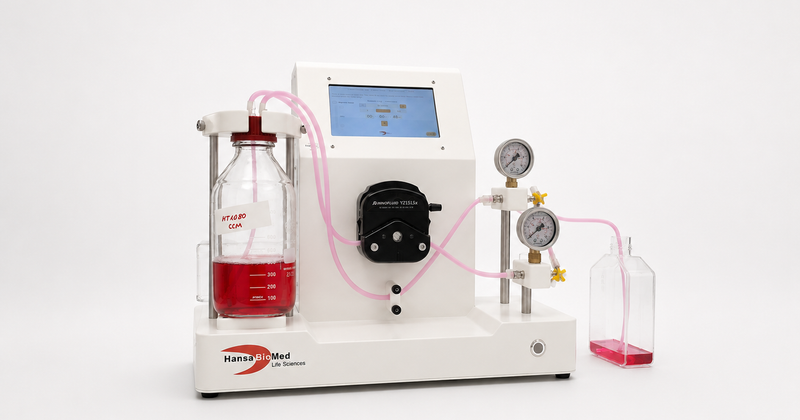
This tech note describes how our optimized EV purification workflow at HansaBioMed can be applied to obtain EVs from bacterial sources. Our isolation and purification method based on TFF allows rapid and easy processing of scalable volumes in a reproducible way, with high yield and purity. This ensures maximization of bacteria EVs’ benefits in various applications.
Materials and Methods
In this study, two different bacterial cultures are processed. Namely, 650 ml of Lactobacillus and Escherichia coli media were processed for purifying EVs. Following sample pre-clearing at low-speed centrifugation, the removal of large particles and debris was performed with TFF-MV having 150-200nm pores (Product code: HBM-TFF-MV), operating with peristaltic pump Masterflex L/S 7535-04 at 60 ml/min flow velocity. Followingly, the filtrate of TFF-MV was processed with TFF-EVs having 50nm pores (Product code: HBM-TFF-EVs-S) using the same peristaltic pump at same velocity. EVs are collected and recovered in PBS. The recovered EVs are then aliquoted in 100µl vials.
Results
Nanoparticle Tracking Analysis (NTA), performed with Zetaview Analyzer (Particle Metrix).
Table 1: Size and concentration measurements performed with Zetaview Analyzer
Transmission Electron Microscopy (TEM) Analysis
BamA expression levels measured by ELISA
Table 2: BamA expression levels of bacteria EVs
Conclusion
HansaBioMed’s optimized EV purification workflow is suitable for isolation and purification of EVs from bacteria with high yield and purity. Such bacteria EVs can be utilized in various applications with well-established QC standards following MISEV2023 guidelines.
References
[1] Dávid Szöllősi, Polett Hajdrik, Hedvig Tordai, Bergmann, R., Ildikó Horváth, Mihály, J., Anikó Gaál, Bálint Jezsó, Kanni Das Shailaja, Tamás Felföldi, Padmanabhan, P., Balázs Zoltán Gulyás, Domokos Máthé, Varga, Z., & Szigeti, K. (2024). Quantitative Biodistribution of OMVs Using SPECT/CT Imaging with HYNIC-Duramycin Radiolabeling. ACS Omega, 9(42), 42808–42813. https://doi.org/10.1021/acsomega.4c04632
[2] Rajan, T. S., Saiganesh, R., Sivagnanavelmurugan, M., & Diomede, F. (2025). Human Skin Microbiota‐Derived Extracellular Vesicles and Their Cosmeceutical Possibilities—A Mini Review. Experimental Dermatology, 34(3). https://doi.org/10.1111/exd.70073
[3] Guo, J., Huang, Z., Wang, Q., Wang, M., Ming, Y., Chen, W., Huang, Y., Tang, Z., Huang, M., Liu, H., & Jia, B. (2025). Opportunities and challenges of bacterial extracellular vesicles in regenerative medicine. Journal of Nanobiotechnology, 23(1). https://doi.org/10.1186/s12951-024-02935-1